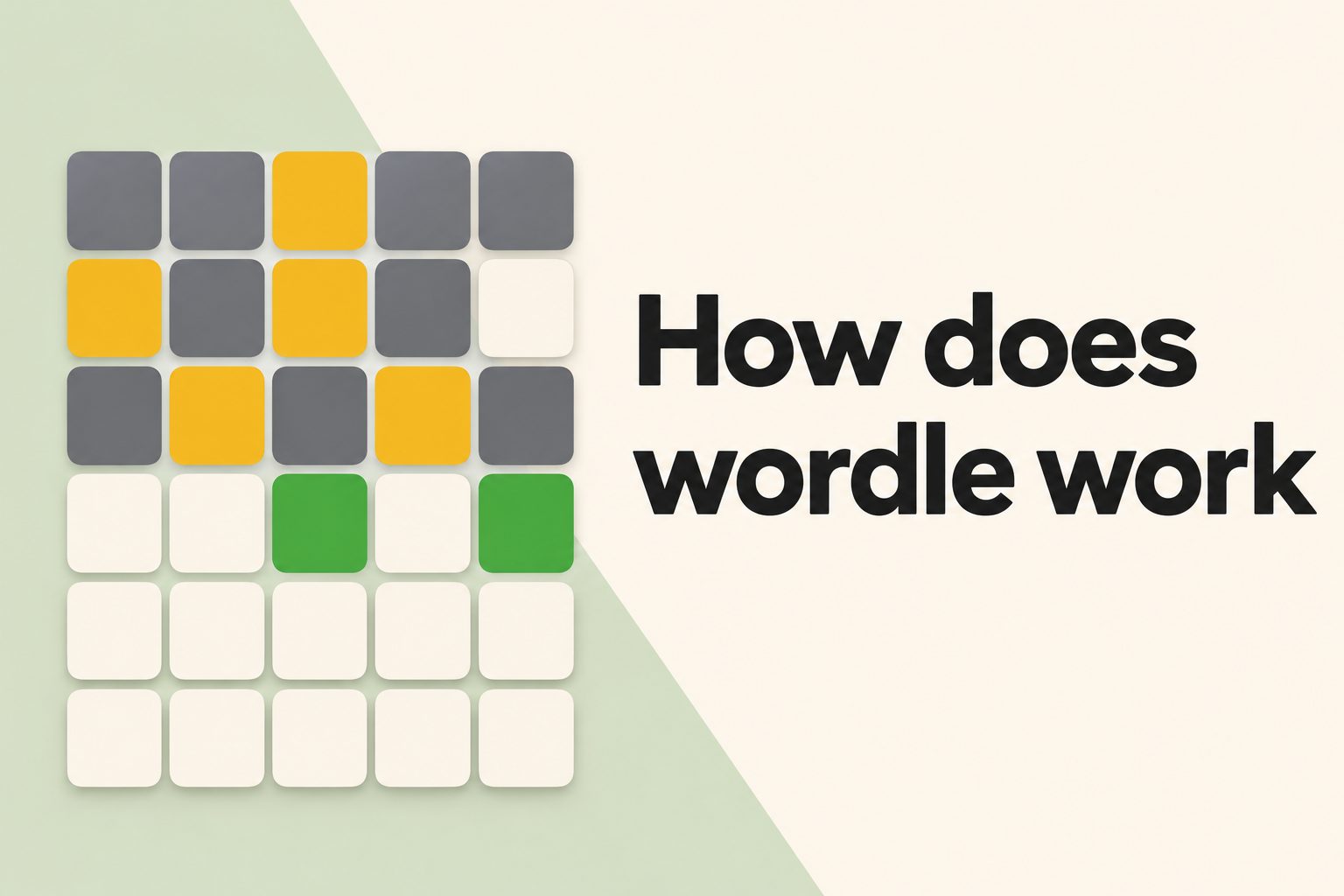
If you have ever wondered how does Wordle work, the answer is simple but cleverly designed: you try to identify one hidden five-letter word in six guesses. Each attempt gives color-coded feedback, turning a quick word puzzle into a satisfying exercise in vocabulary, logic, and pattern recognition.
Wordle became popular because every player faces the same daily answer and can share results without revealing the solution. The game is easy to learn, takes only a few minutes, and still offers enough challenge to reward careful thinking.
This guide explains the rules, tile colors, strategy choices, repeated letters, common mistakes, and useful ways to improve. Whether you are playing for the first time or trying to protect a winning streak, the key is learning how to use every clue efficiently.
At its core, Wordle is a deduction game. You submit a valid five-letter word, then use the feedback to narrow the possible answer. The challenge is not simply knowing many words; it is choosing guesses that reveal the most useful information.
A green tile means the letter is in the answer and already placed in the correct position. That is the strongest clue, because both the letter and its location are confirmed.
A yellow tile means the letter appears somewhere in the answer, but not in the position where you played it. You should keep the letter in mind while testing it in different open positions.
A gray tile usually means the letter does not appear in the answer. Removing gray letters from future guesses is important because it prevents wasted attempts and makes your reasoning more focused.
The game ends when you find the target word or use all six guesses. Because a fresh puzzle normally appears each day, Wordle encourages a short, repeatable routine rather than endless play.
How Do Wordle Tile Colors Guide Your Guess?
Green Tiles Confirm Exact Positions
Treat a green tile as a fixed part of the answer. Keep that letter in the same slot unless you have made a reading error. Your next word should build around confirmed positions while testing new letters in the remaining spaces.
Yellow Tiles Need A New Location
A yellow letter belongs in the solution, but its current placement is wrong. Move it to a different available position on the next guess. Avoid placing it back in the same spot, since the feedback has already ruled that location out.
Gray Tiles Eliminate Options
Gray feedback is valuable because it removes letters from consideration. Many players focus only on colorful tiles, but eliminated letters sharply reduce the number of possible words. Use them to avoid guesses that repeat information you already know.
Keyboard Colors Support Quick Review
The on-screen keyboard records the status of letters you have tested. It is useful for checking which letters are unavailable before submitting another word. Still, read the grid carefully, especially when a word may contain a repeated letter.
Patterns Matter More Than Single Letters
A partial pattern such as a green ending or two confirmed vowels can be more useful than an isolated clue. Look at the empty spaces as a word shape and consider common letter combinations that naturally fit around your confirmed tiles.
Feedback Must Be Read Together
No tile should be interpreted alone. A yellow letter, a gray letter, and a fixed green position together may remove dozens of possibilities. Strong Wordle play comes from combining all clues after every guess instead of following one clue at a time.
What Makes A Strong Wordle Starting Word?
1. Choose common letters such as E, A, R, S, T, N, and L because they appear in many English words and quickly reveal useful patterns.
2. Include at least two vowels when possible, since early vowel information helps you decide which word shapes are realistic.
3. Use five different letters in the first guess so one turn tests more possibilities and reduces uncertainty faster.
4. Avoid unusual spellings or obscure vocabulary at the start because a familiar word gives clearer, more practical feedback.
5. Do not repeat letters in an opening guess unless you have a specific reason; variety is usually more valuable before any clues appear.
Why Wordle Is More Than A Word Game
- Daily Mental Exercise: A short puzzle can encourage focused thinking without requiring a long session. Players practice recall, comparison, and elimination in a compact format.
- Pattern Recognition: The game trains you to notice common endings, vowel placements, consonant pairs, and other language patterns that make likely answers easier to identify.
- Low-Pressure Challenge: Six guesses create tension, but the game remains approachable because every attempt provides feedback. A missed puzzle is usually a learning opportunity rather than a major setback.
- Shared Conversation: Because many people solve the same daily word, results can become a small social ritual. Players can compare guess counts while keeping the answer hidden.
- Vocabulary Awareness: Wordle may introduce less familiar words or make you notice spelling details you normally overlook. It rewards curiosity about how everyday words are constructed.
- Consistent Routine: The once-a-day format helps the game fit naturally into a morning break, commute, or evening wind-down without demanding continuous attention.
How Can You Improve At Wordle?
Use Your First Two Guesses Wisely
Your early turns should gather information, not chase a lucky answer. After an opening word, choose a second guess that tests useful unused letters unless the first result already gives a very clear pattern worth pursuing.
Track Possible Vowels Carefully
Vowels often determine the shape of a five-letter word. Once you know which vowels are present or absent, compare likely placements. Remember that some answers use one vowel repeatedly, while others use two or three different vowels.
Test Common Letter Pairs
English words frequently use combinations such as TH, CH, SH, ST, TR, and ER. When clues leave several possibilities, testing common pairs can expose the intended structure faster than guessing letters at random.
Watch For Repeated Letters
A solution can contain the same letter twice, so do not assume a letter appears only once because you have already found it. Repeated-letter situations often explain feedback that initially seems confusing or incomplete.
Separate Exploration From Solving
When the answer remains wide open, use a guess that explores several new letters. When several positions are fixed, switch to solving directly. Knowing when to gather data and when to commit is a major strategic skill.
Review Before You Submit
Pause for a few seconds before entering each word. Check every green position, make sure yellow letters have moved, and confirm you have not reused gray letters accidentally. This simple review prevents many avoidable losses.
Learn From Finished Puzzles
After a win or loss, think about which clue you overlooked and whether an earlier guess could have tested more letters. Reviewing your choices builds a better instinct for future puzzles without turning the game into a chore.
Wordle works by combining a hidden five-letter word with six increasingly informed guesses. Green, yellow, and gray tiles provide the evidence you need to narrow the answer logically.
The best approach balances vocabulary with disciplined clue reading. Start with varied common letters, preserve confirmed positions, move yellow letters, and stop reusing letters that have been ruled out.
Repeated letters and similar-looking word patterns can make a puzzle difficult, but they are manageable when you review all feedback together. Each game offers another chance to sharpen your method.
Ultimately, Wordle is enjoyable because the rules are simple while the decisions remain meaningful. A calm, systematic approach will make the daily puzzle feel clearer and more rewarding.
FAQs About How Wordle Works
How Many Guesses Do You Get In Wordle?
You get six guesses to find the hidden five-letter word. Every valid guess produces colored feedback, so the goal is to use each attempt to either solve the answer or eliminate as many realistic possibilities as possible.
What Does A Yellow Letter Mean In Wordle?
A yellow tile means the letter is included in the answer, but it is in the wrong position in your submitted word. Keep the letter in future guesses, but place it in a different open slot.
Can A Wordle Answer Use The Same Letter Twice?
Yes, Wordle answers can contain repeated letters. This is why feedback should be read carefully. A letter may appear once in your guess but twice in the answer, or a repeated guess letter may receive different colors.
Do Gray Letters Ever Appear In The Answer?
Usually, a gray letter does not appear in the solution. However, repeated-letter rules can make a tile seem confusing when you use the same letter more than once. Compare the entire row and the number of confirmed copies.
Is There A Best First Word For Wordle?
There is no single guaranteed best opener because the daily answer changes. A strong first word usually contains common letters, multiple vowels, and no repeated characters, giving you broad information before you know the pattern.
Why Do People Share Wordle Results Without Spoilers?
Wordle results are commonly shared as colored square patterns rather than the answer itself. The pattern shows the number of attempts and progression of clues, allowing others to compare performance without losing their own chance to solve.